Surf Coaching · Ericeira · World Surfing Reserve
By Rui Ferreira — Founder of Sea Krew, former competitive athlete, Ericeira, Portugal
I’m going to say something that most surf schools in Portugal won’t: if you’ve been surfing for three, five, or ten years and you’re still “intermediate,” another lesson probably won’t fix it.
I’ve spent my life in the ocean. I competed at the highest level, I’ve coached complete beginners into confident surfers, and I’ve watched strong intermediates stay intermediate for a decade. What I tell every guest who arrives in Ericeira frustrated with their progress is that the intermediate plateau isn’t a technique problem. Not really.
It’s a diagnosis problem. And until you understand that, you’ll keep buying lessons, watching pro edits, and wondering why your surfing doesn’t look any different twelve months from now.
The Lie of “More Water Time”
You’ve heard it a hundred times: “Just surf more. Time in the water is the only thing that matters.” It’s the most comforting advice in surfing. It’s also, for intermediates, mostly wrong.
Here’s the uncomfortable truth I learned on the competition circuit: repetition without feedback entrenches bad habits. Every session you paddle out and do the same wrong thing — the late pop-up, the shoulder-hopping, the stalled bottom turn — you’re not “getting more experience.” You’re getting better at being mediocre.
Beginners progress fast on water time alone because almost anything is an improvement. Intermediates don’t have that luxury. At your level, the gap between “a lot of surfing” and “the right surfing” is the entire game.
The Three Invisible Problems at the Plateau
In over three decades in the water, I’ve seen the intermediate plateau almost always come down to three invisible problems — invisible because you can’t see them from inside your own body.
1. You’re Reading the Wrong Wave
Most intermediates think their problem is technique. It’s almost never technique. It’s wave selection. You’re paddling for waves that are already closing out, or sitting too far on the shoulder, or picking up the tenth wave of the set when the third one was the one you wanted. Your body is trying to execute advanced maneuvers on waves that physically don’t support them. Fix the selection, and half your “technique problems” disappear overnight.
2. You’re Generating No Speed of Your Own
Beginners ride the wave’s energy. Advanced surfers add their own. Intermediates live in the gap — coasting on whatever the wave gives them, wondering why they keep running out of speed before the section. This is a body mechanics issue: compression, extension, rail engagement, where your eyes are looking. From inside your own board, you genuinely feel like you’re pumping. Film yourself once and you’ll see what I see from the channel: you’re not.
3. Your Brain Is Writing Cheques Your Body Can’t Cash
You watch John John. You watch Filipe. You imagine the line you want to draw. Then a real wave comes and your body does what it’s always done — because under pressure, you default to your oldest habit, not your newest intention. Visualising the maneuver and owning the maneuver are completely different skills. The bridge between them isn’t more stoke — it’s deliberate, structured correction, in the water, with someone watching, on the right wave, at the right moment.
Why Ericeira, Specifically
I’ll be honest about why I built Sea Krew here and not somewhere else. Ericeira is Europe’s only World Surfing Reserve — the second in the world — for a reason. Inside a twenty-minute drive you have beach breaks, reef breaks, points, rights, lefts, mellow days and heavy days. For an intermediate trying to break through, that variety isn’t a travel perk. It’s the actual mechanism of progression.
Most intermediate plateaus are built by surfing the same one or two breaks, in the same conditions, year after year. Your body learns one wave. Put you on a different one and you’re suddenly a beginner again — which tells you something important about what you actually know versus what you’ve just memorised.
When I take a guest to four different breaks across one week in Ericeira — a beach break in the morning, a point on the second day, a reef session mid-week — I watch something happen every time. The habits they brought from home stop working. They’re forced to actually surf, rather than execute their usual autopilot sequence. That discomfort is the progression. That’s where the real improvement lives.
In a week here, working with the right coach, you can surf four or five genuinely different wave types. That’s not a holiday. That’s a compressed progression curriculum that would take you a year to assemble on your own — if ever.
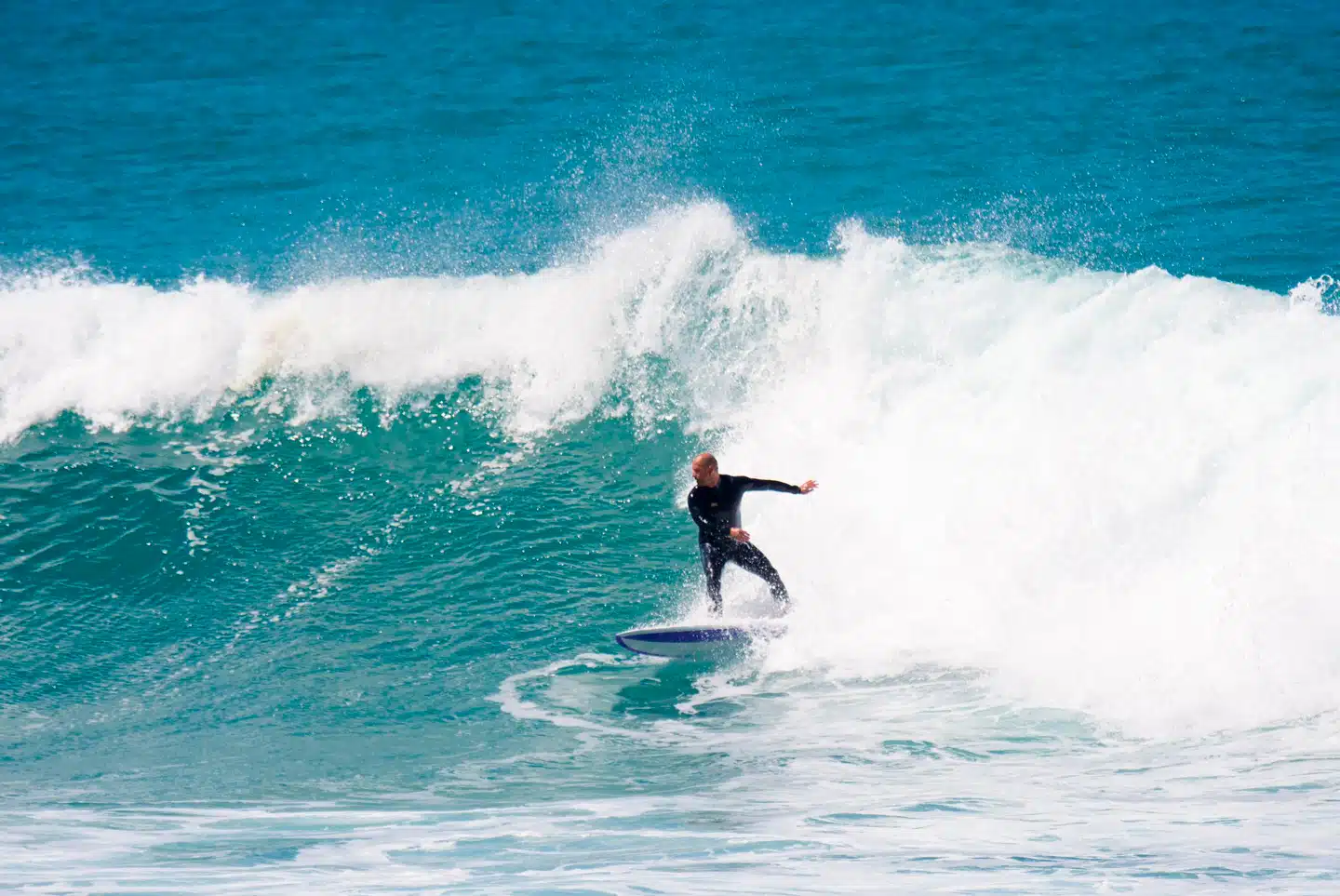
Rui Ferreira — backside bottom turn, Ericeira. Over three decades competing and coaching in this ocean.
What “Real” Intermediate Coaching Looks Like
When someone books Sea Krew for a coaching block, here’s what actually happens — not what the brochure says, what happens in the water:
- Diagnosis first, drills second. Before I prescribe anything, I watch. From the channel, from the beach, on video. I’m not going to fix your bottom turn in the first session. I’m going to figure out whether your bottom turn is even the problem — because usually, it isn’t. The real problem is almost always upstream: the wave you chose, the position you paddled from, the moment you committed.
- Conditions-led sessions, not schedule-led. We don’t surf because it’s 10am on the itinerary. We surf when the tide, wind and swell align with your specific weakness. If today’s conditions naturally expose the thing you need to fix, we go. If not, we adapt. The ocean is the classroom — we work with what it gives us.
- Small groups. Real attention. You cannot coach six intermediates at once and give any of them what they actually need. Anyone who tells you otherwise is running a lesson, not a coaching session. Sea Krew keeps numbers small deliberately — because the ratio is the product.
- Fewer waves, better waves. Five focused waves with real-time corrections — where you paddle back out knowing exactly what to change — beats thirty scrambled attempts every single time. This is the hardest thing for intermediates to accept. They want to surf more. They need to surf smarter.
- Video feedback that actually means something. Seeing yourself surf for the first time is a revelation. Not because it’s painful — though it can be — but because the gap between how you feel on the wave and how you look on it is where all the information lives. We use that gap as the lesson.
The Intermediate Surfer’s Real Enemy: Comfort
Here’s something I’ve observed over decades of coaching: the intermediate plateau is almost always self-maintained. Not because the person isn’t trying — they usually are. But because they’ve found a comfortable version of surfing and they keep returning to it.
They surf the same break. They go on the same type of wave. They execute the same sequence — paddle, pop-up, ride, kick out — and call it a session. It feels like surfing. It looks like surfing. But it’s not producing growth because there’s no friction in it.
Real progression requires targeted discomfort. Not danger — discomfort. The feeling of attempting something you’re not sure you can do. Paddling for a steeper wave than usual. Holding a bottom turn longer than feels safe. Trying a snap on a section you’d normally kick out from. These are the moments where the nervous system updates. These are the moments that add up to an actual change in your surfing.
The problem is that most people can’t manufacture that discomfort for themselves. They need someone to identify the edge, push them toward it, and be there to tell them what happened. That’s what a coach is actually for — not to demonstrate maneuvers, but to move you deliberately to the frontier of your ability, over and over, in controlled conditions.
Ready to break through the plateau — in the right waves, with the right eyes on you?
The Unglamorous Part
Progress at the intermediate level is boring before it’s exciting. You’ll spend a whole session working on where your eyes look at takeoff. You’ll spend another entirely on paddle timing. You’ll make a correction that feels tiny — a small shift in weight, a half-second earlier commitment — and look, on video playback, like a completely different surfer.
That’s it. That’s the whole secret. Not a new board. Not a magic swell window. Not the right destination. Precise, uncomfortable, repeated adjustments — made visible by someone who knows what to look at, and applied consistently over days, not hours.
I’ve seen people arrive in Ericeira after three years of going nowhere and leave five days later surfing genuinely differently. Not dramatically — but measurably. Their wave selection improved. Their pop-up was earlier. Their bottom turn had a line in it. Those are permanent changes. They go home with a different body of knowledge about their own surfing.
That’s what a good coaching week actually produces. Not inspiration. Not stoke. Information — specific, actionable, personalised — that they can apply every session for the rest of their surfing life.
If that’s what you’re ready for, come and work with us in Ericeira. If you’re looking for another week of paddle-outs and general encouragement, there are a hundred schools on this coast happy to take your booking. We do something different. It costs more. It works.
Ready to Actually Progress?
If you’ve been stuck at intermediate for longer than you’d like to admit, we’d rather have an honest conversation than sell you a package. Tell us your dates, your current level, and where you feel stuck — we’ll tell you whether a Sea Krew coaching block is the right move for you.
Rui Ferreira is the founder of Sea Krew and a former professional competitive surfer and bodyboarder with over three decades in the ocean. He coaches year-round from Ericeira — Europe’s only World Surfing Reserve. Learn more about Sea Krew →