
Uncrowded Waves · Ericeira & Santa Cruz
Here is a number worth sitting with. In a busy summer line-up, an average surfer catches somewhere between four and eight waves in a two-hour session. On an empty beach twenty minutes up the coast, the same surfer in the same two hours catches twenty, sometimes thirty.
Nothing about the surfer changed. Everything about the rate of learning did. This is the least glamorous and most important thing nobody tells you when you book a surf trip to Portugal.
By Rui Ferreira — Founder of Sea Krew, surfing and coaching this coast since the 1990s.
The principle: more attempts means faster learning. We coach between Ericeira and Santa Cruz specifically so we can move away from crowds, keep groups small, and give you the maximum number of waves your body can handle in a session.
Santa Cruz: deserted beaches, twenty minutes north
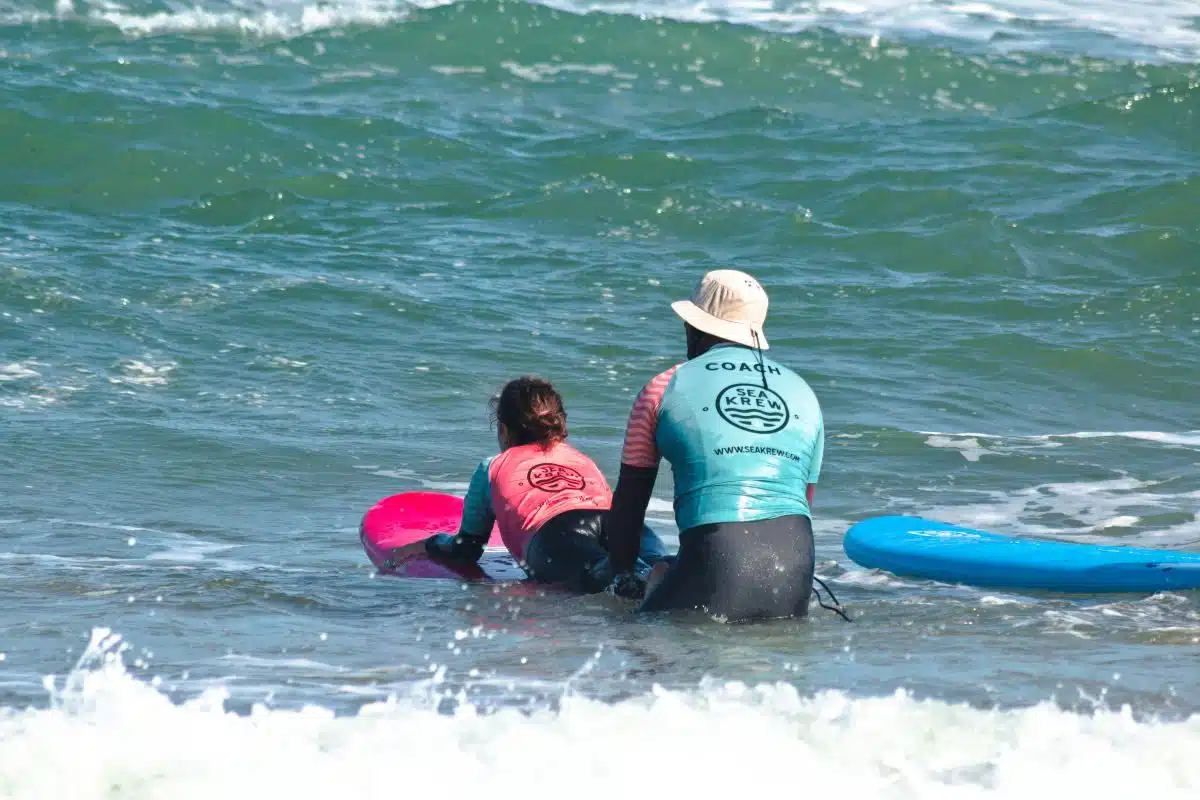
Santa Cruz sits about forty minutes north of Ericeira and gets a fraction of the attention. It is a long stretch of exposed beach break with several peaks, which means people spread out instead of stacking on one takeoff zone.
For a learner or an improver this is close to ideal. You are not competing for waves, you are not waiting your turn behind eleven other students, and when you make a mistake there is nobody in the way. Confidence grows much faster in space than in a queue.
The compounding effect: triple your wave count and you triple the number of times you practise the take-off. Over a five-day camp that is the difference between forty attempts and a hundred and twenty. Progress is mostly a repetition problem.
Your coach watches every wave
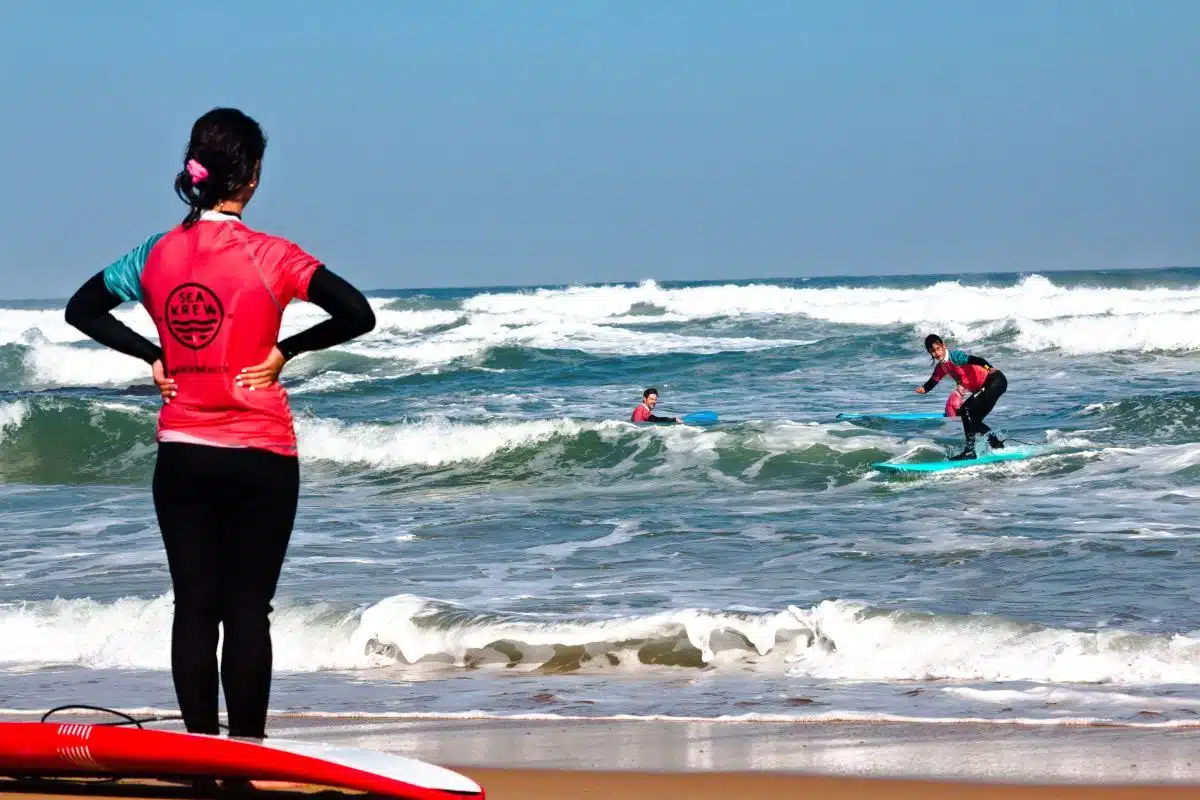
Large schools work on a conveyor belt: push, wave, queue, repeat. The instructor is managing safety for a dozen people and has no capacity to tell you what your back foot did.
We keep groups deliberately small because correction has a very short shelf life. Told thirty seconds after the wave, while your body still remembers the sensation, a correction sticks. Told at the end of the session, it is just information.
Ask before you book anywhere: how many surfers per coach in the water? It is the single most revealing question you can ask a surf school, and the answer predicts your progress better than the price.
We chase conditions, not a fixed beach
Every morning the decision is the same: given this swell direction, this tide, this wind and this group, where is the best water today? Ericeira reef points when it is clean and you are ready for them. Santa Cruz beach breaks when the swell needs space. A sheltered bay when it is too big elsewhere.
Operations tied to one beach cannot do this. They run the lesson where they always run it, and on the wrong day that means an hour of being tumbled in closeouts, which teaches nothing except that surfing is unpleasant.
Honest limitation: chasing conditions means we cannot tell you in advance which beach you will surf on Thursday. If you need a fixed schedule with a fixed location, we are the wrong operation for you.
Quality over quantity, in plain numbers
| Busy city beach | Uncrowded Ericeira / Santa Cruz | |
|---|---|---|
| Waves in 2 hours | 4–8 | 20–30 |
| Surfers per coach | Often 8–12 | Small groups |
| Feedback timing | End of session | Between waves |
| Drop-in risk | High | Low |
| Beach choice | Fixed | Chosen each morning |
Line-up etiquette, and why crowds punish beginners hardest
Surfing has an unwritten rule set that nobody hands you on arrival. The surfer closest to the breaking part of the wave has priority. Do not paddle for a wave someone is already riding. Do not paddle out through the middle of the peak. Apologise when you get it wrong, because everyone does at first.
In an empty line-up these rules barely come up. In a crowded one they are enforced socially, sometimes sharply, and a beginner who does not know them spends the session anxious rather than learning. Space is not just about wave count; it is about being relaxed enough to try things.
The most common beginner mistake: paddling out straight through the takeoff zone because it is the shortest line. Go around the side, even if it takes three extra minutes. It is the difference between being welcome in the water and not.
When crowds are unavoidable, and what we do about it
Some days everywhere is busy. A clean weekend swell in August will draw people to every accessible beach on this coast, and pretending otherwise would be dishonest.
On those days we do three things: start earlier than everyone else, choose the peak that is slightly harder to walk to, and split the group so that half surfs while half reviews video on the sand. It is not magic. It is just refusing to accept the default.
The honest version: if you come in the first two weeks of August expecting empty perfection, no operator on this coast can deliver it. Come in late September and it is close to normal.
Swipe the summary
Frequently asked questions
Where can I surf without crowds in Portugal?
Santa Cruz, about forty minutes north of Ericeira, has long stretches of beach break with several peaks and a fraction of the crowds. Ericeira itself also has quieter options outside the main beaches, especially outside July and August.
How many waves should I catch in a lesson?
On a crowded beach, four to eight in two hours is common. On an uncrowded beach with a small group, twenty or more is realistic. Wave count is the clearest predictor of how fast you improve.
Why do small groups matter in surf coaching?
Because a correction only sticks if it arrives while your body still remembers the wave. With a dozen people per instructor, feedback arrives at the end of the session, when it is just information rather than learning.
Is Santa Cruz better than Ericeira for surfing?
Neither is better. Ericeira has more variety and quality breaks, Santa Cruz has more space. We move between the two depending on swell, tide, wind and the level of the group.
When are Portuguese surf beaches least crowded?
September through May. Autumn combines the emptiest line-ups with warm water and consistent swell, which makes it the best time of year for progression.
Do you always surf the same beach?
No. We choose the beach on the morning based on conditions and the group. That flexibility is the reason we can keep sessions productive on days when a fixed-location school cannot.
Claim your uncrowded line-up
Small groups between Ericeira and Santa Cruz, with the beach chosen each morning for the conditions. Tell us your dates and level.